PHYSICAL DRAIN OPENING TECHNOLOGY
Drain Opener Tools & Pumps: Kinetic Water Rams vs. Chemicals
When a household drain backs up, homeowners are faced with a choice: pour caustic chemical cleaners down the sink, use manual mechanical tools, or call a professional. This comprehensive guide evaluates plungers, closet augers, air burst pumps, and kinetic water rams, explaining the physics of shockwave drain clearing and why chemicals pose severe risks to Elgin's plumbing.
Tool Mechanics & Safety
The Kinetic Water Ram: Physics of Shockwave Clearing
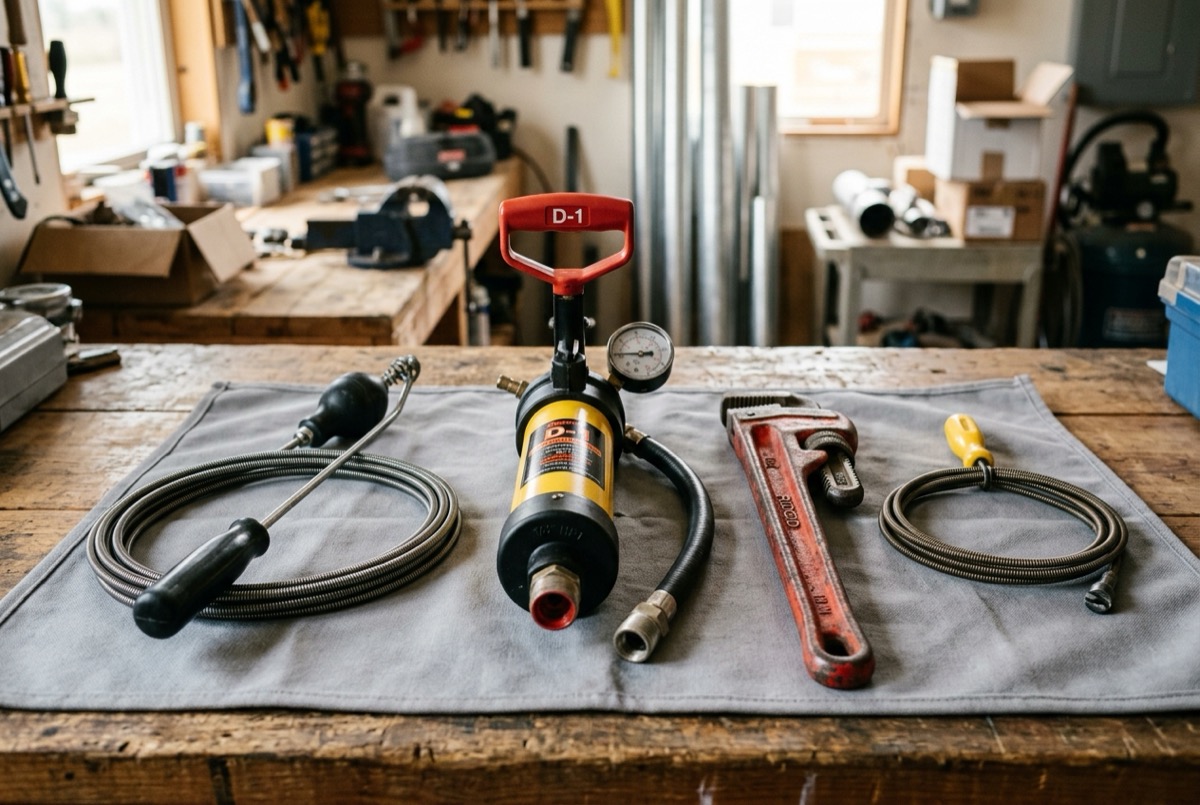
The Kinetic Water Ram (such as the General Pipe Cleaners D-25) is an ingenious drain opener pump that uses compressed air to clear stubborn clogs without electricity or spinning metal cables. The tool features an internal air chamber, a manual hand pump, a calibrated pressure gauge, and a quick-release trigger valve.
The physics behind the tool is fascinating: water is practically incompressible (98% non-compressible), whereas air is highly compressible. When the technician charges the ram to 20 to 40 PSI and fires the trigger, the sudden air burst does not travel down the pipe. Instead, it strikes the standing column of water in the drain, creating a high-velocity kinetic shockwave.
This hydraulic wave travels around 90-degree elbows, through traps, and strikes the face of the clog with 98% of its original kinetic energy, dislodging the blockage instantly while placing zero expansion stress against pipe walls.
Kinetic Water Ram Cutaway & Operation
The schematic below details how the rubber expansion cone seats over a drain opening to seal all air and focus 100% of the kinetic energy against the obstruction:
Kinetic Water Ram & Air Burst Opener Pump Mechanism
Generates an instant 98% non-compressible kinetic shockwave through water to clear clogs without chemical pipe erosion.
Because the kinetic shockwave dissipates within milliseconds and relies on standing water rather than physical abrasion, it is completely safe for delicate vintage cast iron, thin-wall brass traps, and aging PVC lines.
Plunger Mechanics: Flat Cup vs. Accordion vs. Flange
Not all plungers perform the same task. Using the wrong plunger shape accounts for most DIY plunging failures:
- Standard Flat Cup Plunger: Designed exclusively for flat surfaces like kitchen sinks and bathroom vanities. It creates a vacuum over the flat drain rim. It cannot seal curved toilet bowls.
- Flange (Toilet) Plunger: Features an extended rubber collar or horn that folds out from inside the cup. This horn inserts directly into the toilet siphon jet opening, forming an airtight hydraulic seal.
- Accordion Plunger: Made of hard molded plastic with concertina ridges. It generates significantly higher water displacement per stroke, but its stiff plastic lip can scratch porcelain glaze if misaligned.
Why Chemical Drain Openers Damage Vintage Elgin Pipes
Liquid and gel chemical drain cleaners sold in retail stores contain concentrated sulfuric acid, hydrochloric acid, or sodium hydroxide (lye). While they can dissolve hair, their chemical action causes severe structural destruction:
- Exothermic Heat Generation: Chemical cleaners react with water and organic grease, generating temperatures in excess of 180°F. In PVC and ABS plastic pipes, this thermal shock softens joints, melts solvent glue, and warps fittings.
- Accelerated Cast Iron Tuberculation: Acid eats away the protective internal scale of vintage cast iron pipes in Elgin's historic homes, causing premature pitting, pinhole leaks, and bottom wall collapse.
- Technician Hazard: When chemicals fail to clear a stubborn clog, your fixture is left filled with caustic, burning acid. When a technician later disassembles the P-trap, splashing acid poses catastrophic skin and eye burn hazards.
When to Stop DIY and Call a Professional
Homeowners should put down their manual tools and call an Elgin drain specialist when:
- Water is backing up into a secondary fixture (e.g., plunging a toilet causes water to rise in your shower).
- A foreign object (toy, razor, cosmetic bottle) was dropped down the drain—ramming it with a plunger wedges it tighter into the trapway.
- Standing water persists after three moderate plunge attempts. Repeated aggressive plunging blows out the subfloor wax gasket.